Binary Search Tree
Data Structure · Core
Step through it: Binary Tree Traversal pattern
Step 1 of 5
A tree has no single first-to-last order, so we pick one. The three common orders differ only in when a node is visited compared with its children.
Step 2 of 5
Pre-order: the node first, then left, then right. Good for copying a tree.
Step 3 of 5
In-order: left, then the node, then right. On a binary search tree this gives the values in sorted order.
Step 4 of 5
Post-order: left, right, then the node. Children come before their parent, so it is the order for deleting a tree or adding up sizes.
Step 5 of 5
Your turn.
Complexity
Time Complexity
| Access | Search | Insertion | Deletion |
|---|---|---|---|
| O(log(n)) | O(log(n)) | O(log(n)) | O(log(n)) |
Space Complexity
O(n)
In computer science, binary search trees (BST), sometimes called ordered or sorted binary trees, are a particular type of container: data structures that store "items" (such as numbers, names etc.) in memory. They allow fast lookup, addition and removal of items, and can be used to implement either dynamic sets of items, or lookup tables that allow finding an item by its key (e.g., finding the phone number of a person by name).
Binary search trees keep their keys in sorted order, so that lookup and other operations can use the principle of binary search: when looking for a key in a tree (or a place to insert a new key), they traverse the tree from root to leaf, making comparisons to keys stored in the nodes of the tree and deciding, on the basis of the comparison, to continue searching in the left or right subtrees. On average, this means that each comparison allows the operations to skip about half of the tree, so that each lookup, insertion or deletion takes time proportional to the logarithm of the number of items stored in the tree. This is much better than the linear time required to find items by key in an (unsorted) array, but slower than the corresponding operations on hash tables.
A binary search tree of size 9 and depth 3, with 8 at the root. The leaves are not drawn.
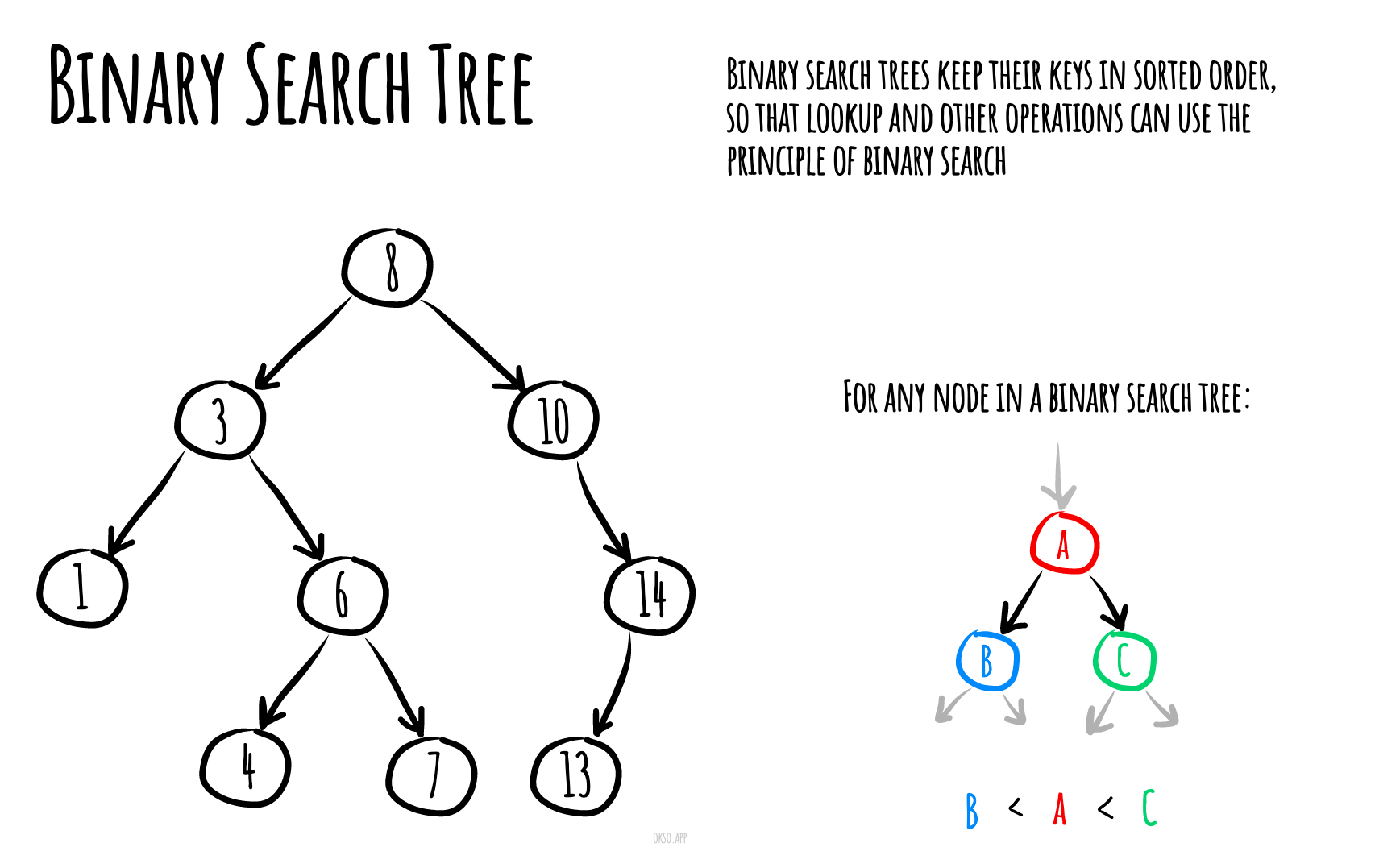
Made with okso.app
Pseudocode for Basic Operations
Insertion
insert(value)
  Pre: value has passed custom type checks for type T
  Post: value has been placed in the correct location in the tree
  if root = ø
    root ← node(value)
  else
    insertNode(root, value)
  end if
end insertinsertNode(current, value)
Pre: current is the node to start from
Post: value has been placed in the correct location in the tree
if value < current.value
if current.left = ø
current.left ← node(value)
else
InsertNode(current.left, value)
end if
else
if current.right = ø
current.right ← node(value)
else
InsertNode(current.right, value)
end if
end if
end insertNodeSearching
contains(root, value)
  Pre: root is the root node of the tree, value is what we would like to locate
  Post: value is either located or not
  if root = ø
    return false
  end if
  if root.value = value
    return true
  else if value < root.value
    return contains(root.left, value)
  else
    return contains(root.right, value)
  end if
end contains
Deletion
remove(value)
  Pre: value is the value of the node to remove, root is the node of the BST
      count is the number of items in the BST
  Post: node with value is removed if found in which case yields true, otherwise false
  nodeToRemove ← findNode(value)
  if nodeToRemove = ø
    return false
  end if
  parent ← findParent(value)
  if count = 1
    root ← ø
  else if nodeToRemove.left = ø and nodeToRemove.right = ø
    if nodeToRemove.value < parent.value
      parent.left ←  nodeToRemove.right
    else
      parent.right ← nodeToRemove.right
    end if
  else if nodeToRemove.left != ø and nodeToRemove.right != ø
    next ← nodeToRemove.right
    while next.left != ø
      next ← next.left
    end while
    if next != nodeToRemove.right
      remove(next.value)
      nodeToRemove.value ← next.value
    else
      nodeToRemove.value ← next.value
      nodeToRemove.right ← nodeToRemove.right.right
    end if
  else
    if nodeToRemove.left = ø
      next ← nodeToRemove.right
    else
      next ← nodeToRemove.left
    end if
    if root = nodeToRemove
      root = next
    else if parent.left = nodeToRemove
      parent.left = next
    else if parent.right = nodeToRemove
      parent.right = next
    end if
  end if
  count ← count - 1
  return true
end remove
Find Parent of Node
findParent(value, root)
  Pre: value is the value of the node we want to find the parent of
       root is the root node of the BST and is != ø
  Post: a reference to the prent node of value if found; otherwise ø
  if value = root.value
    return ø
  end if
  if value < root.value
    if root.left = ø
      return ø
    else if root.left.value = value
      return root
    else
      return findParent(value, root.left)
    end if
  else
    if root.right = ø
      return ø
    else if root.right.value = value
      return root
    else
      return findParent(value, root.right)
    end if
  end if
end findParent
Find Node
findNode(root, value)
  Pre: value is the value of the node we want to find the parent of
       root is the root node of the BST
  Post: a reference to the node of value if found; otherwise ø
  if root = ø
    return ø
  end if
  if root.value = value
    return root
  else if value < root.value
    return findNode(root.left, value)
  else
    return findNode(root.right, value)
  end if
end findNode
Find Minimum
findMin(root)
  Pre: root is the root node of the BST
    root = ø
  Post: the smallest value in the BST is located
  if root.left = ø
    return root.value
  end if
  findMin(root.left)
end findMin
Find Maximum
findMax(root)
  Pre: root is the root node of the BST
    root = ø
  Post: the largest value in the BST is located
  if root.right = ø
    return root.value
  end if
  findMax(root.right)
end findMax
Traversal
InOrder Traversal
inorder(root)
  Pre: root is the root node of the BST
  Post: the nodes in the BST have been visited in inorder
  if root != ø
    inorder(root.left)
    yield root.value
    inorder(root.right)
  end if
end inorder
PreOrder Traversal
preorder(root)
  Pre: root is the root node of the BST
  Post: the nodes in the BST have been visited in preorder
  if root != ø
    yield root.value
    preorder(root.left)
    preorder(root.right)
  end if
end preorder
PostOrder Traversal
postorder(root)
  Pre: root is the root node of the BST
  Post: the nodes in the BST have been visited in postorder
  if root != ø
    postorder(root.left)
    postorder(root.right)
    yield root.value
  end if
end postorder
Code
import BinarySearchTreeNode from './BinarySearchTreeNode';

export default class BinarySearchTree {
  /**
   * @param {function} [nodeValueCompareFunction]
   */
  constructor(nodeValueCompareFunction) {
    this.root = new BinarySearchTreeNode(null, nodeValueCompareFunction);

    // Steal node comparator from the root.
    this.nodeComparator = this.root.nodeComparator;
  }

  /**
   * @param {*} value
   * @return {BinarySearchTreeNode}
   */
  insert(value) {
    return this.root.insert(value);
  }

  /**
   * @param {*} value
   * @return {boolean}
   */
  contains(value) {
    return this.root.contains(value);
  }

  /**
   * @param {*} value
   * @return {boolean}
   */
  remove(value) {
    return this.root.remove(value);
  }

  /**
   * @return {string}
   */
  toString() {
    return this.root.toString();
  }
}import BinaryTreeNode from '../BinaryTreeNode';
import Comparator from '../../../utils/comparator/Comparator';
export default class BinarySearchTreeNode extends BinaryTreeNode {
/**
* @param {*} [value] - node value.
* @param {function} [compareFunction] - comparator function for node values.
*/
constructor(value = null, compareFunction = undefined) {
super(value);
// This comparator is used to compare node values with each other.
this.compareFunction = compareFunction;
this.nodeValueComparator = new Comparator(compareFunction);
}
/**
* @param {*} value
* @return {BinarySearchTreeNode}
*/
insert(value) {
if (this.nodeValueComparator.equal(this.value, null)) {
this.value = value;
return this;
}
if (this.nodeValueComparator.lessThan(value, this.value)) {
// Insert to the left.
if (this.left) {
return this.left.insert(value);
}
const newNode = new BinarySearchTreeNode(value, this.compareFunction);
this.setLeft(newNode);
return newNode;
}
if (this.nodeValueComparator.greaterThan(value, this.value)) {
// Insert to the right.
if (this.right) {
return this.right.insert(value);
}
const newNode = new BinarySearchTreeNode(value, this.compareFunction);
this.setRight(newNode);
return newNode;
}
return this;
}
/**
* @param {*} value
* @return {BinarySearchTreeNode}
*/
find(value) {
// Check the root.
if (this.nodeValueComparator.equal(this.value, value)) {
return this;
}
if (this.nodeValueComparator.lessThan(value, this.value) && this.left) {
// Check left nodes.
return this.left.find(value);
}
if (this.nodeValueComparator.greaterThan(value, this.value) && this.right) {
// Check right nodes.
return this.right.find(value);
}
return null;
}
/**
* @param {*} value
* @return {boolean}
*/
contains(value) {
return !!this.find(value);
}
/**
* @param {*} value
* @return {boolean}
*/
remove(value) {
const nodeToRemove = this.find(value);
if (!nodeToRemove) {
throw new Error('Item not found in the tree');
}
const { parent } = nodeToRemove;
if (!nodeToRemove.left && !nodeToRemove.right) {
// Node is a leaf and thus has no children.
if (parent) {
// Node has a parent. Just remove the pointer to this node from the parent.
parent.removeChild(nodeToRemove);
} else {
// Node has no parent. Just erase current node value.
nodeToRemove.setValue(undefined);
}
} else if (nodeToRemove.left && nodeToRemove.right) {
// Node has two children.
// Find the next biggest value (minimum value in the right branch)
// and replace current value node with that next biggest value.
const nextBiggerNode = nodeToRemove.right.findMin();
if (!this.nodeComparator.equal(nextBiggerNode, nodeToRemove.right)) {
this.remove(nextBiggerNode.value);
nodeToRemove.setValue(nextBiggerNode.value);
} else {
// In case if next right value is the next bigger one and it doesn't have left child
// then just replace node that is going to be deleted with the right node.
nodeToRemove.setValue(nodeToRemove.right.value);
nodeToRemove.setRight(nodeToRemove.right.right);
}
} else {
// Node has only one child.
// Make this child to be a direct child of current node's parent.
/** @var BinarySearchTreeNode */
const childNode = nodeToRemove.left || nodeToRemove.right;
if (parent) {
parent.replaceChild(nodeToRemove, childNode);
} else {
BinaryTreeNode.copyNode(childNode, nodeToRemove);
}
}
// Clear the parent of removed node.
nodeToRemove.parent = null;
return true;
}
/**
* @return {BinarySearchTreeNode}
*/
findMin() {
if (!this.left) {
return this;
}
return this.left.findMin();
}
}References
Practice
Binary Tree Traversal
- Binary Tree Inorder TraversalEasy
- Binary Tree Preorder TraversalEasy
- Binary Tree Postorder TraversalEasy
- Same TreeEasy
- Symmetric TreeEasy
- Invert Binary TreeEasy
- Subtree of Another TreeEasy
- Merge Two Binary TreesEasy
- Construct Binary Tree from Preorder and Inorder TraversalMedium
- Construct Binary Tree from Inorder and Postorder TraversalMedium
- Validate Binary Search TreeMedium
- Kth Smallest Element in a BSTMedium
- Flatten Binary Tree to Linked ListMedium
- Lowest Common Ancestor of a Binary TreeMedium
- Binary Search Tree IteratorMedium
- Recover Binary Search TreeMedium
- Serialize and Deserialize Binary TreeHard
- Binary Tree Maximum Path SumHard
Spotted a mistake or something unclear? Report it on GitHub.