Tree
Data Structure · Core
Step through it: Binary Tree Traversal pattern
Step 1 of 5
A tree has no single first-to-last order, so we pick one. The three common orders differ only in when a node is visited compared with its children.
Step 2 of 5
Pre-order: the node first, then left, then right. Good for copying a tree.
Step 3 of 5
In-order: left, then the node, then right. On a binary search tree this gives the values in sorted order.
Step 4 of 5
Post-order: left, right, then the node. Children come before their parent, so it is the order for deleting a tree or adding up sizes.
Step 5 of 5
Your turn.
- Binary Search Tree
- AVL Tree
- Red-Black Tree
- Segment Tree - with min/max/sum range queries examples
- Fenwick Tree (Binary Indexed Tree)
In computer science, a tree is a widely used abstract data type (ADT) — or data structure implementing this ADT—that simulates a hierarchical tree structure, with a root value and subtrees of children with a parent node, represented as a set of linked nodes.
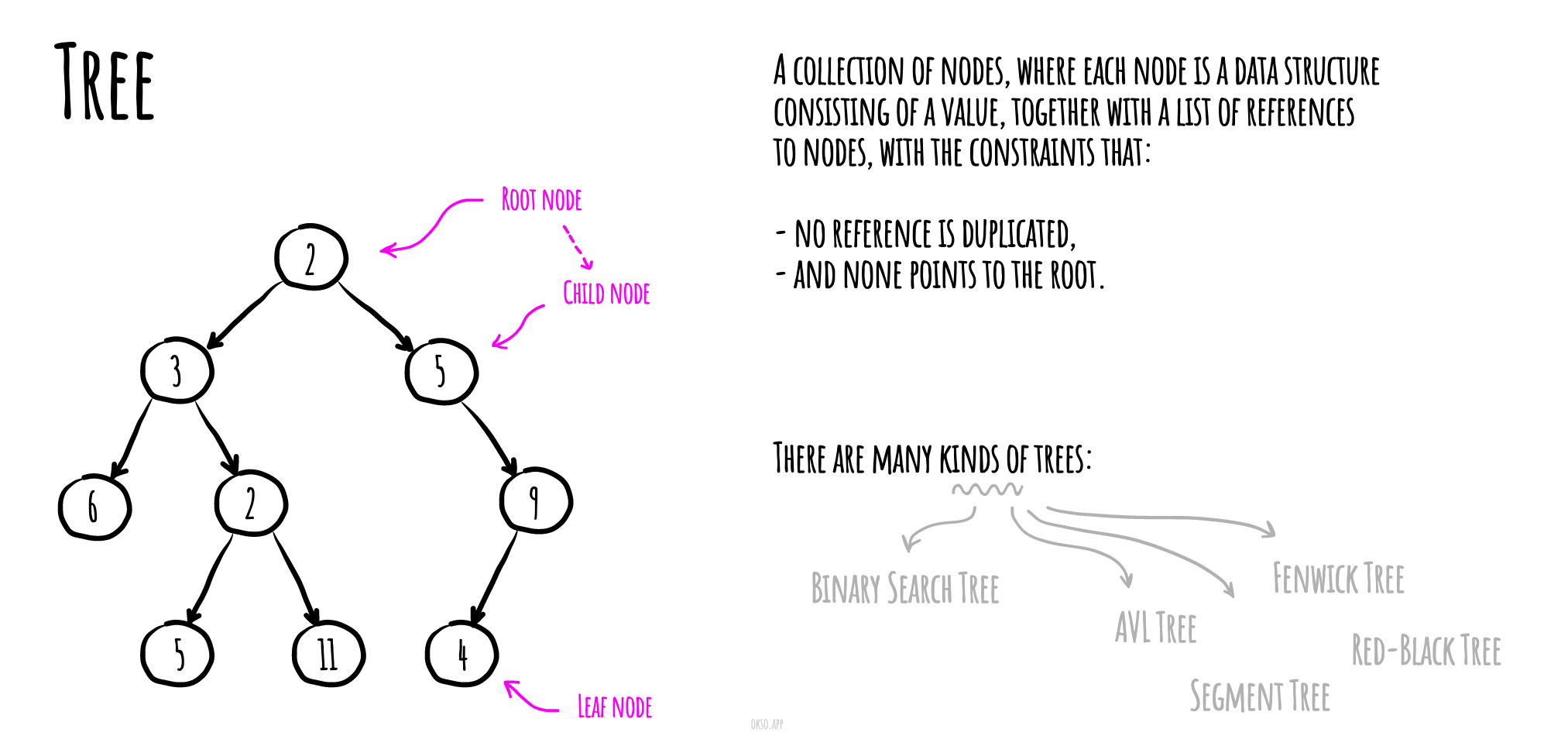
A tree data structure can be defined recursively (locally) as a collection of nodes (starting at a root node), where each node is a data structure consisting of a value, together with a list of references to nodes (the "children"), with the constraints that no reference is duplicated, and none points to the root.
A simple unordered tree; in this diagram, the node labeled 3 has two children, labeled 2 and 6, and one parent, labeled 2. The root node, at the top, has no parent.
Made with okso.app
Code
import Comparator from '../../utils/comparator/Comparator';
import HashTable from '../hash-table/HashTable';

export default class BinaryTreeNode {
  /**
   * @param {*} [value] - node value.
   */
  constructor(value = null) {
    this.left = null;
    this.right = null;
    this.parent = null;
    this.value = value;

    // Any node related meta information may be stored here.
    this.meta = new HashTable();

    // This comparator is used to compare binary tree nodes with each other.
    this.nodeComparator = new Comparator();
  }

  /**
   * @return {number}
   */
  get leftHeight() {
    if (!this.left) {
      return 0;
    }

    return this.left.height + 1;
  }

  /**
   * @return {number}
   */
  get rightHeight() {
    if (!this.right) {
      return 0;
    }

    return this.right.height + 1;
  }

  /**
   * @return {number}
   */
  get height() {
    return Math.max(this.leftHeight, this.rightHeight);
  }

  /**
   * @return {number}
   */
  get balanceFactor() {
    return this.leftHeight - this.rightHeight;
  }

  /**
   * Get parent's sibling if it exists.
   * @return {BinaryTreeNode}
   */
  get uncle() {
    // Check if current node has parent.
    if (!this.parent) {
      return undefined;
    }

    // Check if current node has grand-parent.
    if (!this.parent.parent) {
      return undefined;
    }

    // Check if grand-parent has two children.
    if (!this.parent.parent.left || !this.parent.parent.right) {
      return undefined;
    }

    // So for now we know that current node has grand-parent and this
    // grand-parent has two children. Let's find out who is the uncle.
    if (this.nodeComparator.equal(this.parent, this.parent.parent.left)) {
      // Right one is an uncle.
      return this.parent.parent.right;
    }

    // Left one is an uncle.
    return this.parent.parent.left;
  }

  /**
   * @param {*} value
   * @return {BinaryTreeNode}
   */
  setValue(value) {
    this.value = value;

    return this;
  }

  /**
   * @param {BinaryTreeNode} node
   * @return {BinaryTreeNode}
   */
  setLeft(node) {
    // Reset parent for left node since it is going to be detached.
    if (this.left) {
      this.left.parent = null;
    }

    // Attach new node to the left.
    this.left = node;

    // Make current node to be a parent for new left one.
    if (this.left) {
      this.left.parent = this;
    }

    return this;
  }

  /**
   * @param {BinaryTreeNode} node
   * @return {BinaryTreeNode}
   */
  setRight(node) {
    // Reset parent for right node since it is going to be detached.
    if (this.right) {
      this.right.parent = null;
    }

    // Attach new node to the right.
    this.right = node;

    // Make current node to be a parent for new right one.
    if (node) {
      this.right.parent = this;
    }

    return this;
  }

  /**
   * @param {BinaryTreeNode} nodeToRemove
   * @return {boolean}
   */
  removeChild(nodeToRemove) {
    if (this.left && this.nodeComparator.equal(this.left, nodeToRemove)) {
      this.left = null;
      return true;
    }

    if (this.right && this.nodeComparator.equal(this.right, nodeToRemove)) {
      this.right = null;
      return true;
    }

    return false;
  }

  /**
   * @param {BinaryTreeNode} nodeToReplace
   * @param {BinaryTreeNode} replacementNode
   * @return {boolean}
   */
  replaceChild(nodeToReplace, replacementNode) {
    if (!nodeToReplace || !replacementNode) {
      return false;
    }

    if (this.left && this.nodeComparator.equal(this.left, nodeToReplace)) {
      this.left = replacementNode;
      return true;
    }

    if (this.right && this.nodeComparator.equal(this.right, nodeToReplace)) {
      this.right = replacementNode;
      return true;
    }

    return false;
  }

  /**
   * @param {BinaryTreeNode} sourceNode
   * @param {BinaryTreeNode} targetNode
   */
  static copyNode(sourceNode, targetNode) {
    targetNode.setValue(sourceNode.value);
    targetNode.setLeft(sourceNode.left);
    targetNode.setRight(sourceNode.right);
  }

  /**
   * @return {*[]}
   */
  traverseInOrder() {
    let traverse = [];

    // Add left node.
    if (this.left) {
      traverse = traverse.concat(this.left.traverseInOrder());
    }

    // Add root.
    traverse.push(this.value);

    // Add right node.
    if (this.right) {
      traverse = traverse.concat(this.right.traverseInOrder());
    }

    return traverse;
  }

  /**
   * @return {string}
   */
  toString() {
    return this.traverseInOrder().toString();
  }
}
References
Practice
Binary Tree Traversal
- Binary Tree Inorder TraversalEasy
- Binary Tree Preorder TraversalEasy
- Binary Tree Postorder TraversalEasy
- Same TreeEasy
- Symmetric TreeEasy
- Invert Binary TreeEasy
- Subtree of Another TreeEasy
- Merge Two Binary TreesEasy
- Construct Binary Tree from Preorder and Inorder TraversalMedium
- Construct Binary Tree from Inorder and Postorder TraversalMedium
- Validate Binary Search TreeMedium
- Kth Smallest Element in a BSTMedium
- Flatten Binary Tree to Linked ListMedium
- Lowest Common Ancestor of a Binary TreeMedium
- Binary Search Tree IteratorMedium
- Recover Binary Search TreeMedium
- Serialize and Deserialize Binary TreeHard
- Binary Tree Maximum Path SumHard
Spotted a mistake or something unclear? Report it on GitHub.