Linked List
Data Structure · Starter
Step through it: Fast & Slow Pointers pattern
both start at node 1
Step 1 of 6
Question: does this chain of nodes loop back on itself? Walking it one node at a time never answers that, because inside a loop you just keep going. Instead send two walkers from the start: a slow one moving 1 node per step and a fast one moving 2.
Step 2 of 6
After one step the slow walker is on node 2 and the fast one on node 3.
Step 3 of 6
Again: slow on 3, fast on 5, the last node.
Step 4 of 6
The last node points back to 3, so fast carries on 5 → 3 → 4 while slow steps to 4. They land on the same node.
Step 5 of 6
Why they must meet: inside a loop the fast walker gains one node on the slow one every step, so it catches up. Without a loop, fast would simply fall off the end (null) first. Two walkers at different speeds is called fast and slow pointers.
Step 6 of 6
Your turn.
Complexity
Time Complexity
| Access | Search | Insertion | Deletion |
|---|---|---|---|
| O(n) | O(n) | O(1) | O(n) |
Space Complexity
O(n)
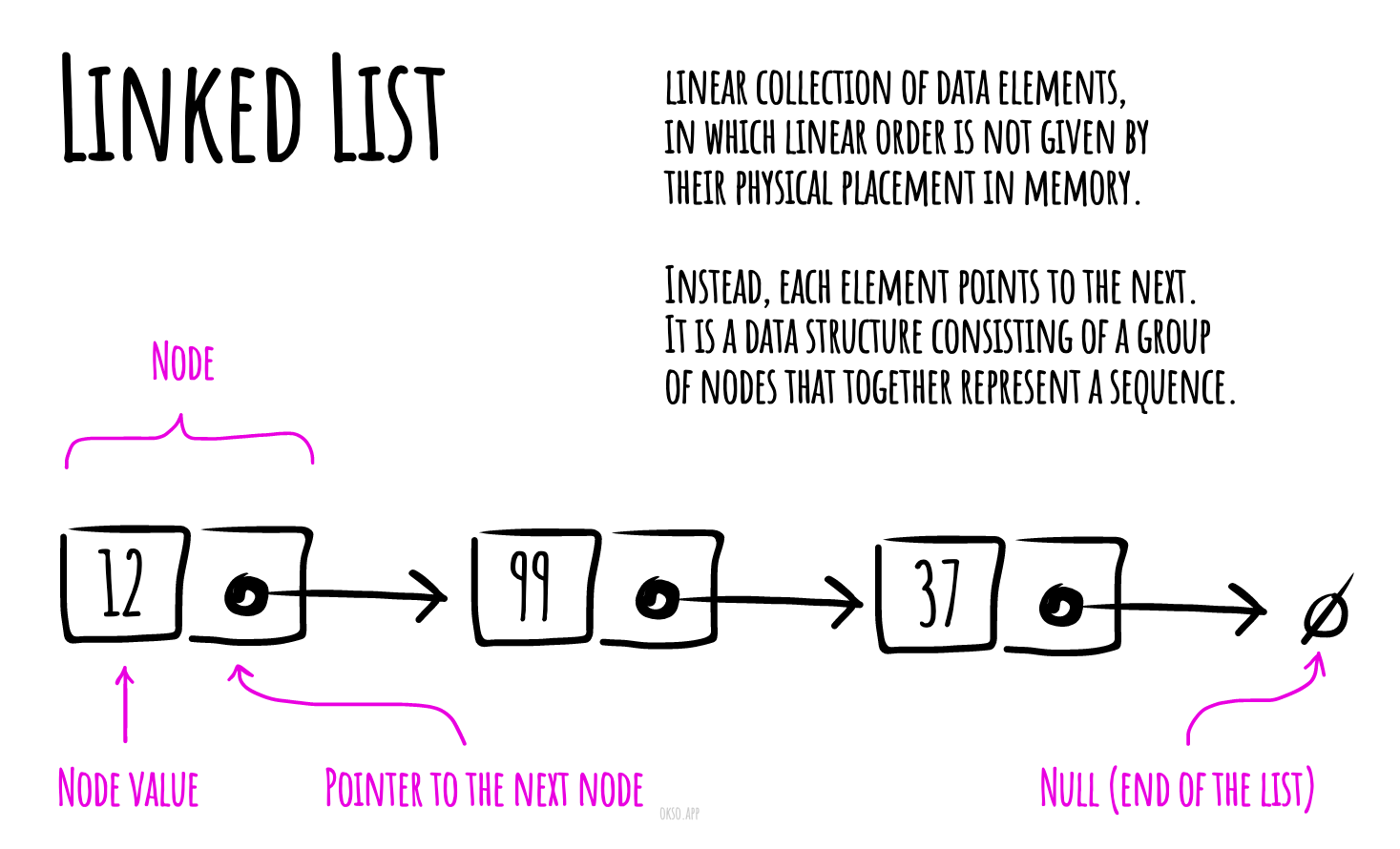
In computer science, a linked list is a linear collection of data elements, in which linear order is not given by their physical placement in memory. Instead, each element points to the next. It is a data structure consisting of a group of nodes which together represent a sequence. Under the simplest form, each node is composed of data and a reference (in other words, a link) to the next node in the sequence. This structure allows for efficient insertion or removal of elements from any position in the sequence during iteration. More complex variants add additional links, allowing efficient insertion or removal from arbitrary element references. A drawback of linked lists is that access time is linear (and difficult to pipeline). Faster access, such as random access, is not feasible. Arrays have better cache locality as compared to linked lists.
Made with okso.app
Pseudocode for Basic Operations
Insert
Add(value)
  Pre: value is the value to add to the list
  Post: value has been placed at the tail of the list
  n ← node(value)
  if head = ø
    head ← n
    tail ← n
  else
    tail.next ← n
    tail ← n
  end if
end AddPrepend(value)
Pre: value is the value to add to the list
Post: value has been placed at the head of the list
n ← node(value)
n.next ← head
head ← n
if tail = ø
tail ← n
end
end PrependSearch
Contains(head, value)
  Pre: head is the head node in the list
       value is the value to search for
  Post: the item is either in the linked list, true; otherwise false
  n ← head
  while n != ø and n.value != value
    n ← n.next
  end while
  if n = ø
    return false
  end if
  return true
end Contains
Delete
Remove(head, value)
  Pre: head is the head node in the list
       value is the value to remove from the list
  Post: value is removed from the list, true, otherwise false
  if head = ø
    return false
  end if
  n ← head
  if n.value = value
    if head = tail
      head ← ø
      tail ← ø
    else
      head ← head.next
    end if
    return true
  end if
  while n.next != ø and n.next.value != value
    n ← n.next
  end while
  if n.next != ø
    if n.next = tail
      tail ← n
      tail.next = null
    else
      n.next ← n.next.next
    end if
    return true
  end if
  return false
end Remove
Traverse
Traverse(head)
  Pre: head is the head node in the list
  Post: the items in the list have been traversed
  n ← head
  while n != ø
    yield n.value
    n ← n.next
  end while
end Traverse
Traverse in Reverse
ReverseTraversal(head, tail)
  Pre: head and tail belong to the same list
  Post: the items in the list have been traversed in reverse order
  if tail != ø
    curr ← tail
    while curr != head
      prev ← head
      while prev.next != curr
        prev ← prev.next
      end while
      yield curr.value
      curr ← prev
    end while
   yield curr.value
  end if
end ReverseTraversal
Code
import LinkedListNode from './LinkedListNode';
import Comparator from '../../utils/comparator/Comparator';

export default class LinkedList {
  /**
   * @param {Function} [comparatorFunction]
   */
  constructor(comparatorFunction) {
    /** @var LinkedListNode */
    this.head = null;

    /** @var LinkedListNode */
    this.tail = null;

    this.compare = new Comparator(comparatorFunction);
  }

  /**
   * @param {*} value
   * @return {LinkedList}
   */
  prepend(value) {
    // Make new node to be a head.
    const newNode = new LinkedListNode(value, this.head);
    this.head = newNode;

    // If there is no tail yet let's make new node a tail.
    if (!this.tail) {
      this.tail = newNode;
    }

    return this;
  }

  /**
   * @param {*} value
   * @return {LinkedList}
   */
  append(value) {
    const newNode = new LinkedListNode(value);

    // If there is no head yet let's make new node a head.
    if (!this.head) {
      this.head = newNode;
      this.tail = newNode;

      return this;
    }

    // Attach new node to the end of linked list.
    this.tail.next = newNode;
    this.tail = newNode;

    return this;
  }

  /**
   * @param {*} value
   * @param {number} index
   * @return {LinkedList}
   */
  insert(value, rawIndex) {
    const index = rawIndex < 0 ? 0 : rawIndex;
    if (index === 0) {
      this.prepend(value);
    } else {
      let count = 1;
      let currentNode = this.head;
      const newNode = new LinkedListNode(value);
      while (currentNode) {
        if (count === index) break;
        currentNode = currentNode.next;
        count += 1;
      }
      if (currentNode) {
        newNode.next = currentNode.next;
        currentNode.next = newNode;
      } else {
        if (this.tail) {
          this.tail.next = newNode;
          this.tail = newNode;
        } else {
          this.head = newNode;
          this.tail = newNode;
        }
      }
    }
    return this;
  }

  /**
   * @param {*} value
   * @return {LinkedListNode}
   */
  delete(value) {
    if (!this.head) {
      return null;
    }

    let deletedNode = null;

    // If the head must be deleted then make next node that is different
    // from the head to be a new head.
    while (this.head && this.compare.equal(this.head.value, value)) {
      deletedNode = this.head;
      this.head = this.head.next;
    }

    let currentNode = this.head;

    if (currentNode !== null) {
      // If next node must be deleted then make next node to be a next next one.
      while (currentNode.next) {
        if (this.compare.equal(currentNode.next.value, value)) {
          deletedNode = currentNode.next;
          currentNode.next = currentNode.next.next;
        } else {
          currentNode = currentNode.next;
        }
      }
    }

    // Check if tail must be deleted.
    if (this.compare.equal(this.tail.value, value)) {
      this.tail = currentNode;
    }

    return deletedNode;
  }

  /**
   * @param {Object} findParams
   * @param {*} findParams.value
   * @param {function} [findParams.callback]
   * @return {LinkedListNode}
   */
  find({ value = undefined, callback = undefined }) {
    if (!this.head) {
      return null;
    }

    let currentNode = this.head;

    while (currentNode) {
      // If callback is specified then try to find node by callback.
      if (callback && callback(currentNode.value)) {
        return currentNode;
      }

      // If value is specified then try to compare by value..
      if (value !== undefined && this.compare.equal(currentNode.value, value)) {
        return currentNode;
      }

      currentNode = currentNode.next;
    }

    return null;
  }

  /**
   * @return {LinkedListNode}
   */
  deleteTail() {
    const deletedTail = this.tail;

    if (this.head === this.tail) {
      // There is only one node in linked list.
      this.head = null;
      this.tail = null;

      return deletedTail;
    }

    // If there are many nodes in linked list...

    // Rewind to the last node and delete "next" link for the node before the last one.
    let currentNode = this.head;
    while (currentNode.next) {
      if (!currentNode.next.next) {
        currentNode.next = null;
      } else {
        currentNode = currentNode.next;
      }
    }

    this.tail = currentNode;

    return deletedTail;
  }

  /**
   * @return {LinkedListNode}
   */
  deleteHead() {
    if (!this.head) {
      return null;
    }

    const deletedHead = this.head;

    if (this.head.next) {
      this.head = this.head.next;
    } else {
      this.head = null;
      this.tail = null;
    }

    return deletedHead;
  }

  /**
   * @param {*[]} values - Array of values that need to be converted to linked list.
   * @return {LinkedList}
   */
  fromArray(values) {
    values.forEach((value) => this.append(value));

    return this;
  }

  /**
   * @return {LinkedListNode[]}
   */
  toArray() {
    const nodes = [];

    let currentNode = this.head;
    while (currentNode) {
      nodes.push(currentNode);
      currentNode = currentNode.next;
    }

    return nodes;
  }

  /**
   * @param {function} [callback]
   * @return {string}
   */
  toString(callback) {
    return this.toArray().map((node) => node.toString(callback)).toString();
  }

  /**
   * Reverse a linked list.
   * @returns {LinkedList}
   */
  reverse() {
    let currNode = this.head;
    let prevNode = null;
    let nextNode = null;

    while (currNode) {
      // Store next node.
      nextNode = currNode.next;

      // Change next node of the current node so it would link to previous node.
      currNode.next = prevNode;

      // Move prevNode and currNode nodes one step forward.
      prevNode = currNode;
      currNode = nextNode;
    }

    // Reset head and tail.
    this.tail = this.head;
    this.head = prevNode;

    return this;
  }
}export default class LinkedListNode {
constructor(value, next = null) {
this.value = value;
this.next = next;
}
toString(callback) {
return callback ? callback(this.value) : `${this.value}`;
}
}References
Practice
Fast & Slow Pointers
- Linked List CycleEasy
- Middle of the Linked ListEasy
- Palindrome Linked ListEasy
- Happy NumberEasy
- Linked List Cycle IIMedium
- Find the Duplicate NumberMedium
- Remove Nth Node From End of ListMedium
- Reorder ListMedium
- Sort ListMedium
- Circular Array LoopMedium
- Delete the Middle Node of a Linked ListMedium
- Rotate ListMedium
- Intersection of Two Linked ListsMedium
In-Place Reversal
- Reverse Linked ListEasy
- Merge Two Sorted ListsEasy
- Remove Linked List ElementsEasy
- Remove Duplicates from Sorted ListEasy
- Reverse Linked List IIMedium
- Swap Nodes in PairsMedium
- Add Two NumbersMedium
- Odd Even Linked ListMedium
- Partition ListMedium
- Remove Duplicates from Sorted List IIMedium
- Rotate ListMedium
- Swapping Nodes in a Linked ListMedium
- Reverse Nodes in k-GroupHard
- Merge k Sorted ListsHard
Spotted a mistake or something unclear? Report it on GitHub.