Least Recently Used (LRU) Cache
Data Structure · Core
Step through it: Hash Map / Set Lookup pattern
Step 1 of 5
Goal: find two numbers in [2, 7, 11, 15] that add up to 9. Checking every pair is slow. Trick: for a number x, the partner we need is 9 - x. If we remember every number seen so far, "have I seen the partner?" is answered instantly.
Step 2 of 5
First number: 2. Its partner would be 7. Nothing is remembered yet, so write down 2 (at position 0).
Step 3 of 5
Next number: 7. Its partner would be 2, and 2 is written down at position 0. Found: positions 0 and 1.
Step 4 of 5
Each lookup in the remembered list (a hash map) takes one step, so the whole search is a single pass instead of checking every pair. Trading a little memory for speed is the hash map pattern.
Step 5 of 5
Your turn.
Complexity
| Average | |
|---|---|
| Space | O(n) |
| Get item | O(1) |
| Set item | O(1) |
A Least Recently Used (LRU) Cache organizes items in order of use, allowing you to quickly identify which item hasn't been used for the longest amount of time.
Picture a clothes rack, where clothes are always hung up on one side. To find the least-recently used item, look at the item on the other end of the rack.
The problem statement
Implement the LRUCache class:
LRUCache(int capacity)Initialize the LRU cache with positive sizecapacity.int get(int key)Return the value of thekeyif thekeyexists, otherwise returnundefined.void set(int key, int value)Update the value of thekeyif thekeyexists. Otherwise, add thekey-valuepair to the cache. If the number of keys exceeds thecapacityfrom this operation, evict the least recently used key.
The functions get() and set() must each run in O(1) average time complexity.
Implementation
Version 1: Doubly Linked List + Hash Map
See the LRUCache implementation example in LRUCache.js. The solution uses a HashMap for fast O(1) (in average) cache items access, and a DoublyLinkedList for fast O(1) (in average) cache items promotions and eviction (to keep the maximum allowed cache capacity).
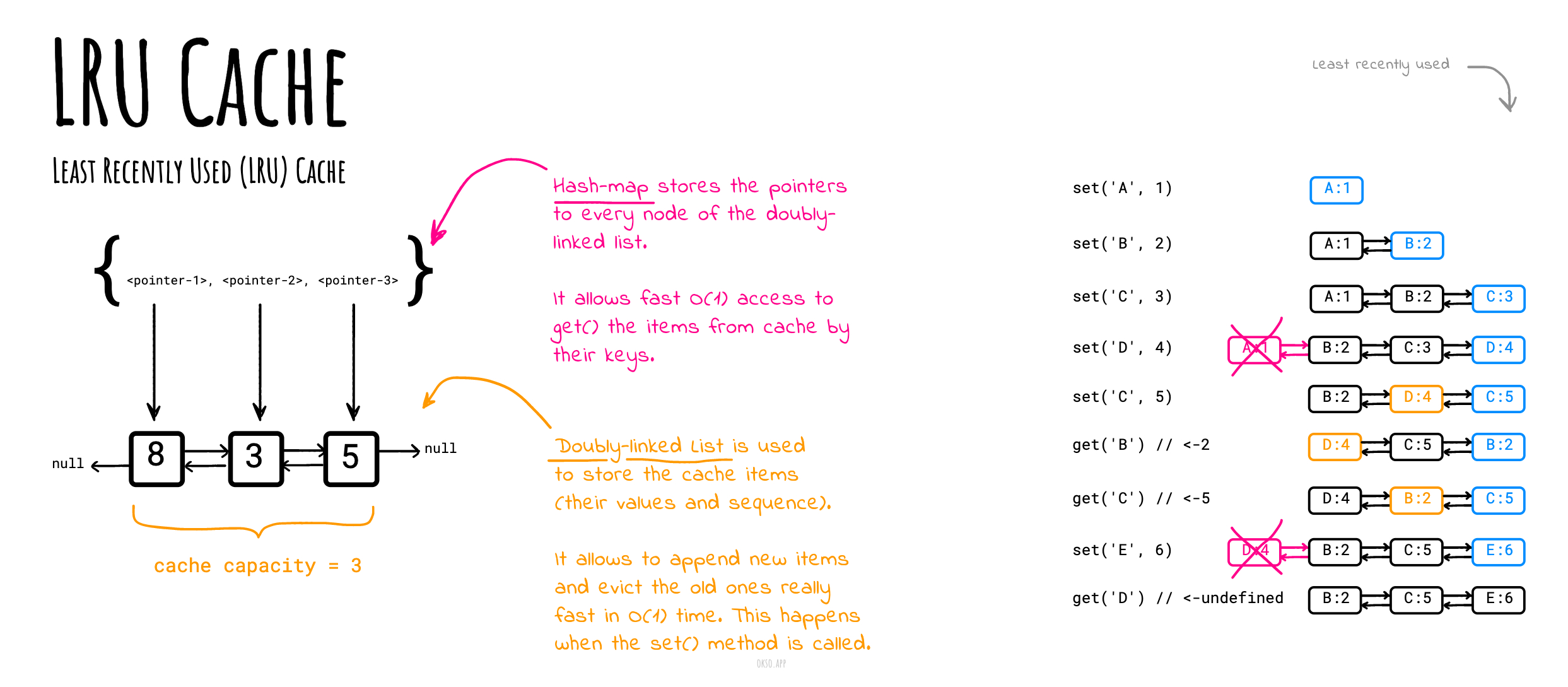
Made with okso.app
You may also find more test-case examples of how the LRU Cache works in LRUCache.test.js file.
Version 2: Ordered Map
The first implementation that uses doubly linked list is good for learning purposes and for better understanding of how the average O(1) time complexity is achievable while doing set() and get().
However, the simpler approach might be to use a JavaScript Map object. The Map object holds key-value pairs and remembers the original insertion order of the keys. We can use this fact in order to keep the recently-used items in the "end" of the map by removing and re-adding items. The item at the beginning of the Map is the first one to be evicted if cache capacity overflows. The order of the items may checked by using the IterableIterator like map.keys().
See the LRUCacheOnMap implementation example in LRUCacheOnMap.js.
You may also find more test-case examples of how the LRU Cache works in LRUCacheOnMap.test.js file.
Code
/* eslint-disable no-param-reassign, max-classes-per-file */

/**
 * Simple implementation of the Doubly-Linked List Node
 * that is used in LRUCache class below.
 */
class LinkedListNode {
  /**
   * Creates a doubly-linked list node.
   * @param {string} key
   * @param {any} val
   * @param {LinkedListNode} prev
   * @param {LinkedListNode} next
   */
  constructor(key, val, prev = null, next = null) {
    this.key = key;
    this.val = val;
    this.prev = prev;
    this.next = next;
  }
}

/**
 * Implementation of the LRU (Least Recently Used) Cache
 * based on the HashMap and Doubly Linked List data-structures.
 *
 * Current implementation allows to have fast O(1) (in average) read and write operations.
 *
 * At any moment in time the LRU Cache holds not more that "capacity" number of items in it.
 */
class LRUCache {
  /**
   * Creates a cache instance of a specific capacity.
   * @param {number} capacity
   */
  constructor(capacity) {
    this.capacity = capacity; // How many items to store in cache at max.
    this.nodesMap = {}; // The quick links to each linked list node in cache.
    this.size = 0; // The number of items that is currently stored in the cache.
    this.head = new LinkedListNode(); // The Head (first) linked list node.
    this.tail = new LinkedListNode(); // The Tail (last) linked list node.
  }

  /**
   * Returns the cached value by its key.
   * Time complexity: O(1) in average.
   * @param {string} key
   * @returns {any}
   */
  get(key) {
    if (this.nodesMap[key] === undefined) return undefined;
    const node = this.nodesMap[key];
    this.promote(node);
    return node.val;
  }

  /**
   * Sets the value to cache by its key.
   * Time complexity: O(1) in average.
   * @param {string} key
   * @param {any} val
   */
  set(key, val) {
    if (this.nodesMap[key]) {
      const node = this.nodesMap[key];
      node.val = val;
      this.promote(node);
    } else {
      const node = new LinkedListNode(key, val);
      this.append(node);
    }
  }

  /**
   * Promotes the node to the end of the linked list.
   * It means that the node is most frequently used.
   * It also reduces the chance for such node to get evicted from cache.
   * @param {LinkedListNode} node
   */
  promote(node) {
    this.evict(node);
    this.append(node);
  }

  /**
   * Appends a new node to the end of the cache linked list.
   * @param {LinkedListNode} node
   */
  append(node) {
    this.nodesMap[node.key] = node;

    if (!this.head.next) {
      // First node to append.
      this.head.next = node;
      this.tail.prev = node;
      node.prev = this.head;
      node.next = this.tail;
    } else {
      // Append to an existing tail.
      const oldTail = this.tail.prev;
      oldTail.next = node;
      node.prev = oldTail;
      node.next = this.tail;
      this.tail.prev = node;
    }

    this.size += 1;

    if (this.size > this.capacity) {
      this.evict(this.head.next);
    }
  }

  /**
   * Evicts (removes) the node from cache linked list.
   * @param {LinkedListNode} node
   */
  evict(node) {
    delete this.nodesMap[node.key];
    this.size -= 1;

    const prevNode = node.prev;
    const nextNode = node.next;

    // If one and only node.
    if (prevNode === this.head && nextNode === this.tail) {
      this.head.next = null;
      this.tail.prev = null;
      this.size = 0;
      return;
    }

    // If this is a Head node.
    if (prevNode === this.head) {
      nextNode.prev = this.head;
      this.head.next = nextNode;
      return;
    }

    // If this is a Tail node.
    if (nextNode === this.tail) {
      prevNode.next = this.tail;
      this.tail.prev = prevNode;
      return;
    }

    // If the node is in the middle.
    prevNode.next = nextNode;
    nextNode.prev = prevNode;
  }
}

export default LRUCache;/* eslint-disable no-restricted-syntax, no-unreachable-loop */
/**
* Implementation of the LRU (Least Recently Used) Cache
* based on the (ordered) Map data-structure.
*
* Current implementation allows to have fast O(1) (in average) read and write operations.
*
* At any moment in time the LRU Cache holds not more that "capacity" number of items in it.
*/
class LRUCacheOnMap {
/**
* Creates a cache instance of a specific capacity.
* @param {number} capacity
*/
constructor(capacity) {
this.capacity = capacity; // How many items to store in cache at max.
this.items = new Map(); // The ordered hash map of all cached items.
}
/**
* Returns the cached value by its key.
* Time complexity: O(1) in average.
* @param {string} key
* @returns {any}
*/
get(key) {
if (!this.items.has(key)) return undefined;
const val = this.items.get(key);
this.items.delete(key);
this.items.set(key, val);
return val;
}
/**
* Sets the value to cache by its key.
* Time complexity: O(1).
* @param {string} key
* @param {any} val
*/
set(key, val) {
this.items.delete(key);
this.items.set(key, val);
if (this.items.size > this.capacity) {
for (const headKey of this.items.keys()) {
this.items.delete(headKey);
break;
}
}
}
}
export default LRUCacheOnMap;References
Practice
Hash Map / Set Lookup
- Two SumEasy
- Contains DuplicateEasy
- Valid AnagramEasy
- Ransom NoteEasy
- Isomorphic StringsEasy
- Intersection of Two ArraysEasy
- Majority ElementEasy
- Single NumberEasy
- Group AnagramsMedium
- Longest Consecutive SequenceMedium
- LRU CacheMedium
- Insert Delete GetRandom O(1)Medium
- Encode and Decode TinyURLMedium
- 4Sum IIMedium
- Brick WallMedium
- Custom Sort StringMedium
- LFU CacheHard
- All O`one Data StructureHard
Spotted a mistake or something unclear? Report it on GitHub.