Radix Sort
Algorithm · Stretch
Step through it: Sort First pattern
Step 1 of 4
Goal: does the list contain a duplicate? Checking every pair works but is slow. Idea: sort first, so equal numbers end up side by side.
Step 2 of 4
After sorting: 2, 2, 5, 7, 9. Equal numbers are now neighbours.
Step 3 of 4
Now one pass comparing each number with the next: 2 and 2 match. Duplicate found. Sorting often turns a hard search into a simple neighbour check, and makes tricks like two pointers and interval merging possible.
Step 4 of 4
Your turn.
Complexity
| Name | Best | Average | Worst | Memory | Stable | Comments |
|---|---|---|---|---|---|---|
| Radix sort | n * k | n * k | n * k | n + k | Yes | k - length of longest key |
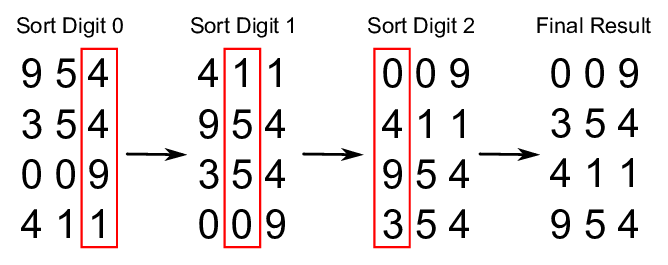
In computer science, radix sort is a non-comparative integer sorting algorithm that sorts data with integer keys by grouping keys by the individual digits which share the same significant position and value. A positional notation is required, but because integers can represent strings of characters (e.g., names or dates) and specially formatted floating point numbers, radix sort is not limited to integers.
Where does the name come from?
In mathematical numeral systems, the radix or base is the number of unique digits, including the digit zero, used to represent numbers in a positional numeral system. For example, a binary system (using numbers 0 and 1) has a radix of 2 and a decimal system (using numbers 0 to 9) has a radix of 10.
Efficiency
The topic of the efficiency of radix sort compared to other sorting algorithms is
somewhat tricky and subject to quite a lot of misunderstandings. Whether radix
sort is equally efficient, less efficient or more efficient than the best
comparison-based algorithms depends on the details of the assumptions made.
Radix sort complexity is O(wn) for n keys which are integers of word size w.
Sometimes w is presented as a constant, which would make radix sort better
(for sufficiently large n) than the best comparison-based sorting algorithms,
which all perform O(n log n) comparisons to sort n keys. However, in
general w cannot be considered a constant: if all n keys are distinct,
then w has to be at least log n for a random-access machine to be able to
store them in memory, which gives at best a time complexity O(n log n). That
would seem to make radix sort at most equally efficient as the best
comparison-based sorts (and worse if keys are much longer than log n).
Code
import Sort from '../Sort';

// Using charCode (a = 97, b = 98, etc), we can map characters to buckets from 0 - 25
const BASE_CHAR_CODE = 97;
const NUMBER_OF_POSSIBLE_DIGITS = 10;
const ENGLISH_ALPHABET_LENGTH = 26;

export default class RadixSort extends Sort {
  /**
   * @param {*[]} originalArray
   * @return {*[]}
   */
  sort(originalArray) {
    // Assumes all elements of array are of the same type
    const isArrayOfNumbers = this.isArrayOfNumbers(originalArray);

    let sortedArray = [...originalArray];
    const numPasses = this.determineNumPasses(sortedArray);

    for (let currentIndex = 0; currentIndex < numPasses; currentIndex += 1) {
      const buckets = isArrayOfNumbers
        ? this.placeElementsInNumberBuckets(sortedArray, currentIndex)
        : this.placeElementsInCharacterBuckets(sortedArray, currentIndex, numPasses);

      // Flatten buckets into sortedArray, and repeat at next index
      sortedArray = buckets.reduce((acc, val) => {
        return [...acc, ...val];
      }, []);
    }

    return sortedArray;
  }

  /**
   * @param {*[]} array
   * @param {number} index
   * @return {*[]}
   */
  placeElementsInNumberBuckets(array, index) {
    // See below. These are used to determine which digit to use for bucket allocation
    const modded = 10 ** (index + 1);
    const divided = 10 ** index;
    const buckets = this.createBuckets(NUMBER_OF_POSSIBLE_DIGITS);

    array.forEach((element) => {
      this.callbacks.visitingCallback(element);
      if (element < divided) {
        buckets[0].push(element);
      } else {
        /**
         * Say we have element of 1,052 and are currently on index 1 (starting from 0). This means
         * we want to use '5' as the bucket. `modded` would be 10 ** (1 + 1), which
         * is 100. So we take 1,052 % 100 (52) and divide it by 10 (5.2) and floor it (5).
         */
        const currentDigit = Math.floor((element % modded) / divided);
        buckets[currentDigit].push(element);
      }
    });

    return buckets;
  }

  /**
   * @param {*[]} array
   * @param {number} index
   * @param {number} numPasses
   * @return {*[]}
   */
  placeElementsInCharacterBuckets(array, index, numPasses) {
    const buckets = this.createBuckets(ENGLISH_ALPHABET_LENGTH);

    array.forEach((element) => {
      this.callbacks.visitingCallback(element);
      const currentBucket = this.getCharCodeOfElementAtIndex(element, index, numPasses);
      buckets[currentBucket].push(element);
    });

    return buckets;
  }

  /**
   * @param {string} element
   * @param {number} index
   * @param {number} numPasses
   * @return {number}
   */
  getCharCodeOfElementAtIndex(element, index, numPasses) {
    // Place element in last bucket if not ready to organize
    if ((numPasses - index) > element.length) {
      return ENGLISH_ALPHABET_LENGTH - 1;
    }

    /**
     * If each character has been organized, use first character to determine bucket,
     * otherwise iterate backwards through element
     */
    const charPos = index > element.length - 1 ? 0 : element.length - index - 1;

    return element.toLowerCase().charCodeAt(charPos) - BASE_CHAR_CODE;
  }

  /**
   * Number of passes is determined by the length of the longest element in the array.
   * For integers, this log10(num), and for strings, this would be the length of the string.
   */
  determineNumPasses(array) {
    return this.getLengthOfLongestElement(array);
  }

  /**
   * @param {*[]} array
   * @return {number}
   */
  getLengthOfLongestElement(array) {
    if (this.isArrayOfNumbers(array)) {
      return Math.floor(Math.log10(Math.max(...array))) + 1;
    }

    return array.reduce((acc, val) => {
      return val.length > acc ? val.length : acc;
    }, -Infinity);
  }

  /**
   * @param {*[]} array
   * @return {boolean}
   */
  isArrayOfNumbers(array) {
    // Assumes all elements of array are of the same type
    return this.isNumber(array[0]);
  }

  /**
   * @param {number} numBuckets
   * @return {*[]}
   */
  createBuckets(numBuckets) {
    /**
     * Mapping buckets to an array instead of filling them with
     * an array prevents each bucket from containing a reference to the same array
     */
    return new Array(numBuckets).fill(null).map(() => []);
  }

  /**
   * @param {*} element
   * @return {boolean}
   */
  isNumber(element) {
    return Number.isInteger(element);
  }
}
References
Practice
Sort First
- Contains DuplicateEasy
- Valid AnagramEasy
- Meeting RoomsEasy
- Merge Sorted ArrayEasy
- Sort ColorsMedium
- Largest NumberMedium
- H-IndexMedium
- Wiggle Sort IIMedium
- Sort an ArrayMedium
- Custom Sort StringMedium
- Insertion Sort ListMedium
- Maximum GapHard
- Count of Smaller Numbers After SelfHard
Spotted a mistake or something unclear? Report it on GitHub.